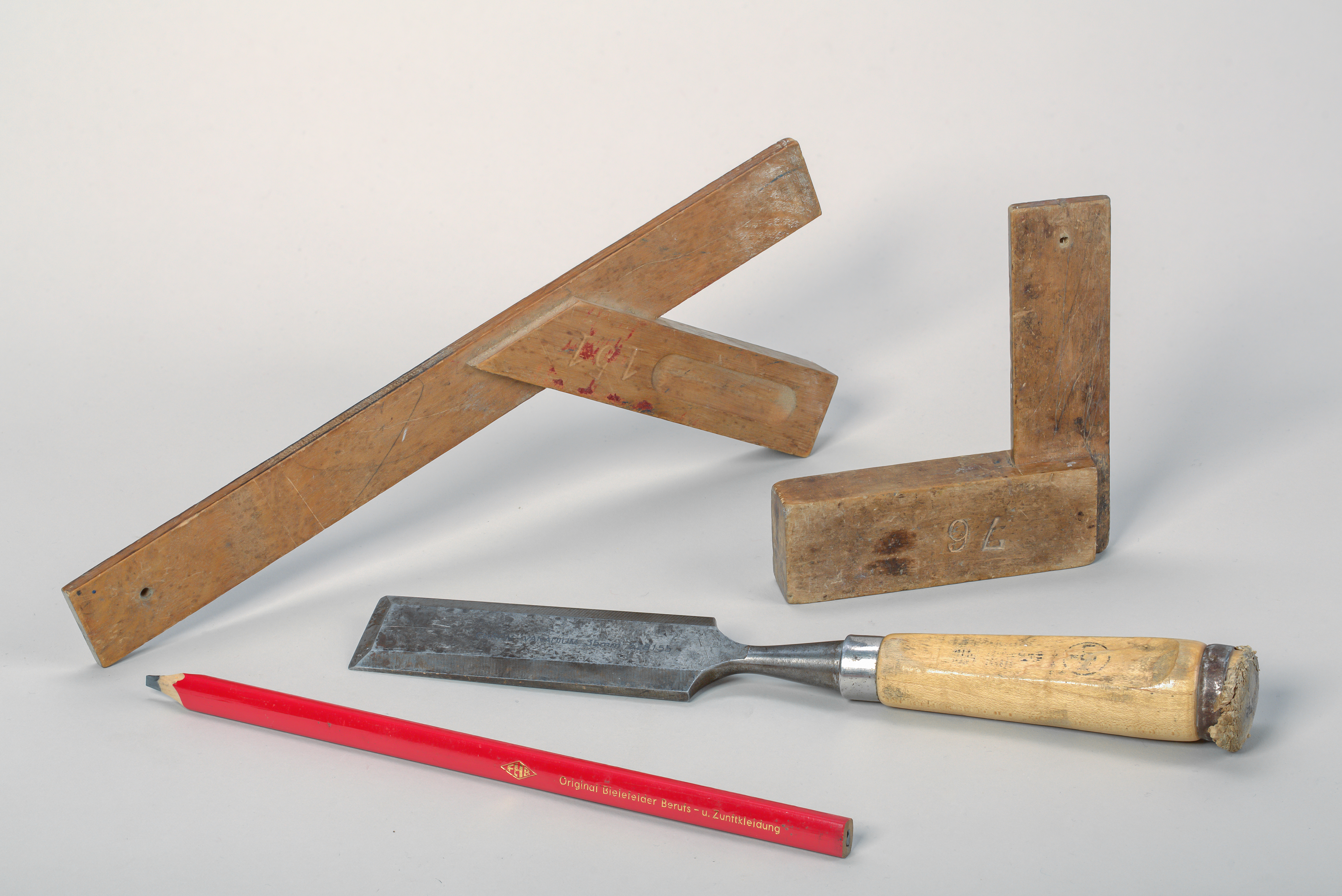
The number of tools a workshop contains is not directly related to the quality of work it produces. A functional set for hand-tool furniture making in a small space — a garage, a basement, a spare room — fits comfortably in two or three tool rolls and a saw till. The challenge is not acquiring tools but selecting the ones that address real limitations in the work rather than hypothetical ones.
This article covers the four categories that form the functional core of a hand-tool workshop: bench planes, chisels, saws, and marking tools. Each section notes which specific items within the category are worth prioritising and why, with reference to the materials and project types common in Czech small-scale woodworking.
Bench Planes
A bench plane is a cutting tool with a flat sole that registers against the wood surface, controlling the depth of cut to a consistent thickness across the full length of the pass. The iron is bedded at an angle (typically 45° on bevel-down planes, 38° on bevel-up) and the depth is adjusted by a lever cap and adjuster knob. Three planes cover the work that most furniture projects require.
No. 5 Jack Plane
The jack plane (approximately 380mm sole length, 50mm iron width) is the workhorse for dimensioning rough stock — reducing thickness after the saw mill, flattening faces before layout, and removing wind from twisted boards. The iron is typically set with a slight camber (a convex profile across the width) that allows aggressive cutting without the corners digging into the surface. This plane does the bulk of the physically demanding preparation work.
For a workshop sourcing rough-sawn timber from Czech sawmills — where thickness tolerances of ±3mm are normal — a jack plane set to take a 0.5–0.8mm shaving removes material efficiently without overworking the tool. The iron needs to be re-sharpened after approximately 20 minutes of heavy use on dense species like beech or oak.
No. 4 Smoothing Plane
The smoothing plane (approximately 245mm sole, 50mm iron) takes the final pass on a surface before finishing. The iron is set fine — typically 0.1–0.2mm of projection — with the cap iron set 0.3–0.5mm behind the cutting edge. This tight cap iron setting is the single most important adjustment for eliminating tearout on difficult grain: it breaks the chip before it can lever up fibers ahead of the cut.
A well-tuned No. 4 produces a surface that requires no sanding on straight-grained beech, walnut, or oak. On figured or interlocked grain, a higher cutting angle (55–60° achieved by skewing the plane or using a high-angle frog) reduces tearout further. This matters for the oak and ash species common in Czech furniture work.
Router Plane
The router plane holds a small cutting iron at a fixed depth relative to a reference surface. It is the correct tool for cleaning the bottom of a housing dado, a stopped groove, or a hinge recess to a flat, consistent depth. No other common hand tool replicates this function reliably. Both the Stanley 71 pattern and the Veritas version are available through European tool suppliers; the Veritas has a superior iron retention mechanism that maintains depth setting under repeated use.

Chisels
A bench chisel in a woodworking context is a bevel-edge chisel: the sides of the blade are beveled to allow access to the corners of a mortise or dovetail socket without the chisel body fouling on the adjacent wall. The bevel-back style (flat back, beveled face) is used in Japanese-style tools; European-style bench chisels have a flat back — critical for registration against a layout line — and the cutting edge is formed by the intersection of the flat back and the ground bevel on the face.
Which Sizes
A set of four chisels covers nearly all standard work: 6mm, 12mm, 19mm, and 25mm. The 6mm is used for small mortises and paring tight corners; the 12mm for standard furniture mortises on 36–44mm stock; the 19mm for paring large shoulders and cleaning dovetail sockets; the 25mm for wide work and chamfering. A 38mm chisel is occasionally useful for wide housing dados but is not essential for a starting kit.
Steel and Sharpening
The steel specification of a chisel determines how long the edge holds between sharpenings and how easily it sharpens. O1 tool steel (oil-hardened) is the traditional choice: it sharpens quickly on water or oil stones, holds an edge adequately on softwoods and medium-density hardwoods, but dulls relatively fast on dense species like beech. A2 steel (air-hardened, typically around 60 HRC) holds an edge longer but requires more abrasive work at the sharpening stage. For a workshop where sharpening time is limited, A2 is practical; for a workshop where frequent, quick touch-ups are preferred, O1 is more suitable.
In the Czech market, Narex chisels (manufactured in Prachatice) represent accessible quality at a price point well below imported European brands. The standard Narex bench chisel in chrome-vanadium steel performs adequately for most furniture work after flattening the back and establishing the bevel angle at 25–30°.
Saws
The two saw types that a hand-tool woodworker reaches for most frequently are the tenon saw and the carcass saw. Both are back saws — a heavy brass or steel back keeps the thin blade in tension, preventing buckling during the cut.
Tenon Saw
A tenon saw with a 300–350mm blade and 10–12 teeth per inch is the primary tool for cutting tenons, dadoes, and the straight cuts in dovetail work. The rip-filed teeth cut efficiently along the grain; the cross-filed alternative is used for cutting across the grain on thick stock. In practice, a rip-filed tenon saw cuts across the grain adequately on hardwoods if the teeth are fine enough (12 tpi) — many makers use a single rip saw for both orientations and reserve the crosscut pattern for a larger panel saw.
Carcass Saw
The carcass saw (200–250mm blade, 14–16 tpi, cross-filed) produces fine, accurate cuts across the grain for trimming components to final length. Its shorter blade length gives more control in tight spaces. This is the saw for cutting dovetail tails and pins to final length after the joint is fitted.
Panel Saw
A cross-cut panel saw (500–550mm, 8–10 tpi) handles breakdown of sheet material and rough-cutting of rough timber to workable lengths. It is a utility tool rather than a precision one, and the quality requirements are less demanding than for back saws. A decent hardpoint panel saw — where the teeth are hardened and cannot be re-sharpened — works adequately for this rough work and costs less than a quality back saw.
Marking Tools
Precision layout is the foundation of accurate joinery. The measurement transferred to the wood defines the dimension the cut attempts to achieve. The tools used for this marking must produce a consistent, fine line that can be held to with a saw or chisel.
Marking Knife
A marking knife scribes a line across the grain by severing the wood fibers rather than compressing them, as a pencil does. The knife line is thinner and more precise than a pencil line and creates a small shoulder that registers the chisel during paring. For layout work — marking dovetail shoulders, scribe lines for mortises, transferring tail profiles to pin boards — the marking knife is the primary tool. The Stanley 1902 pattern and the Japanese kiridashi are both functional; the blade geometry should allow the flat back of the knife to register against a straight edge while the bevel is inclined toward the waste.
Marking Gauge and Mortise Gauge
A marking gauge scribes a line parallel to an edge at a set distance. A mortise gauge has two scribing pins that mark both sides of a mortise simultaneously, ensuring consistency across all components in a batch. The fence of both tools must be set securely — any movement during the scribing pass introduces an error that shows as a misaligned shoulder or an off-centre mortise. Wheel gauges (with a small round cutter rather than a pin) produce a cleaner line on hardwoods by slicing rather than scoring.
Combination Square
A 300mm combination square with an accurate 90° head and a reliable 45° setting covers most of the layout functions in furniture making: checking faces for square, marking shoulder lines, setting transfer measurements. The accuracy of the square should be verified against a known-true reference — a machinist's square or a carefully checked straightedge — when new, and periodically thereafter. A square that is 0.2° out of true introduces a cumulative error in a 400mm-wide carcass that produces a visible gap at the back corner after assembly.
What to Defer
A compact workshop does not need a shoulder plane (the router plane covers most of its use cases), a side rebate plane (rarely needed outside specialist work), a full set of moulding planes (a scratch stock handles occasional moulding profiles at lower cost), or a large collection of spoke shaves (one flat-soled spoke shave handles the majority of curved work on chairs and legs).
The limiting factor in every workshop at the beginning is not the number of tools but sharpness. Two hours spent establishing a good bevel on a set of four chisels and setting up a No. 4 plane produce more improvement in work quality than acquiring five additional tools that are not maintained to a workable edge.
Last updated: May 1, 2026